OUÏVIA · IN DEVELOPMENT · Alberta is our first commercial market See our progress ↗
Built around the worker

A working life.
A hearing history.
Connected.

Jobs change. Test providers change. A worker’s hearing history should follow them.

Ouïvia — Hearing Pathway — is our offline-first Field and Office platform for occupational audiometric testing. Built around the employer appointment and the worker’s continuing hearing history. Starting in Alberta.

Ouïvia Field + Ouïvia Office · Under active development

Offline field workflow Worker-centred history CADS, created by Aud-Can Alberta first. Canada ahead.
Ouïvia Field + Ouïvia Office

From the testing booth
to the office.

Designed around the day-to-day work of hearing-test companies, from the testing booth to the office. Native Windows Field and Office development prototypes exist. Calendar-led appointments and automatic authenticated synchronization are planned capabilities, not available production features.

01 / FIELD

Test around the appointment.

The planned working day starts with an employer appointment calendar, opens worksite details and roster, then moves into two-booth testing. The development prototype already supports independent fictional worker forms and local draft storage.

  • Calendar, employer appointments and worker search — planned
  • Two-booth offline testing forms — prototype
  • Automatic sync and appointment completion — in development
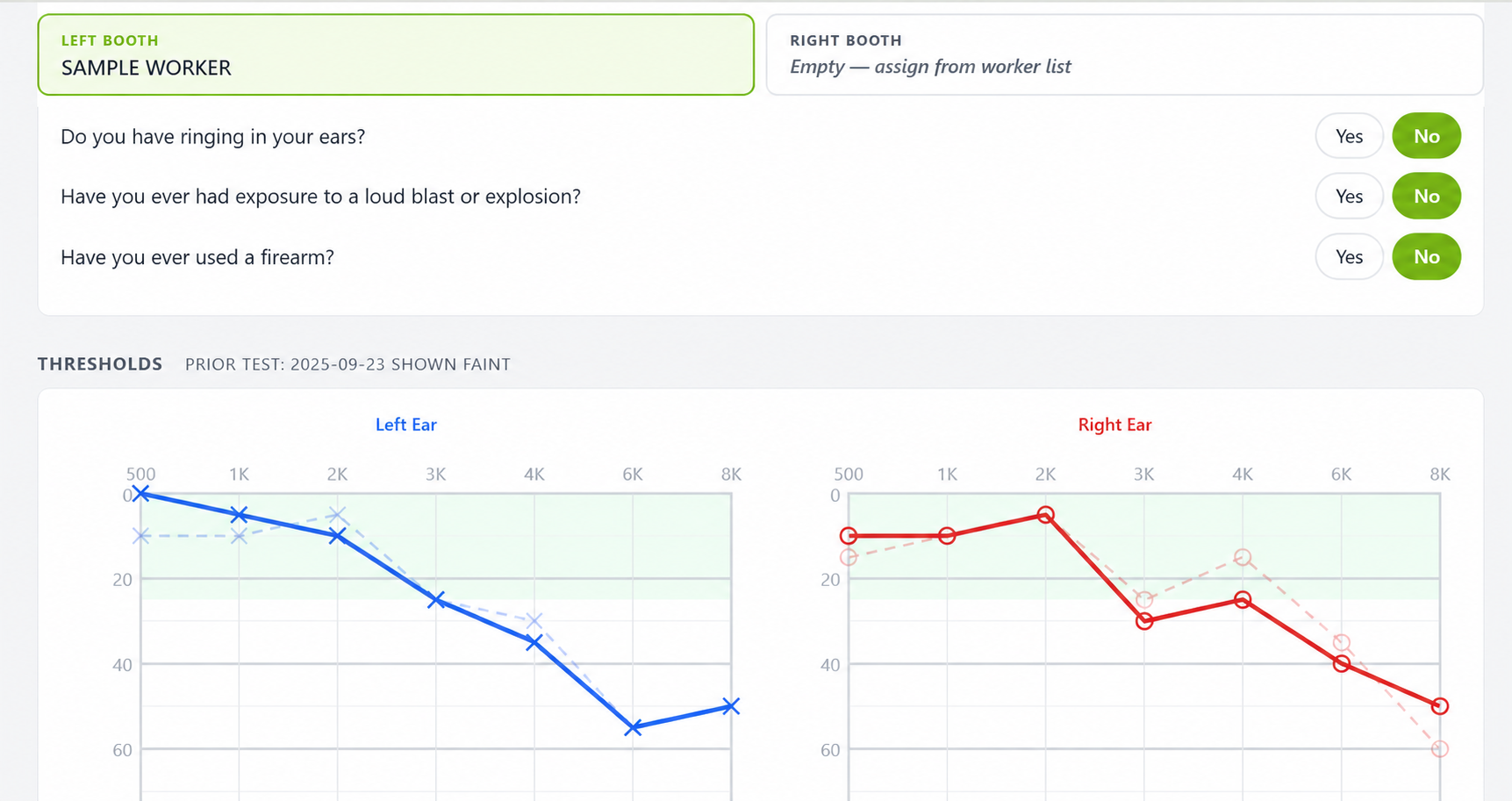
Field app with left and right booths, worker questionnaire, and left and right ear audiograms. Employee name replaced with SAMPLE WORKER.
Development Field prototype · Edited to show a sample name
View full-size preview ↗
02 / OFFICE

Coordinate the whole service.

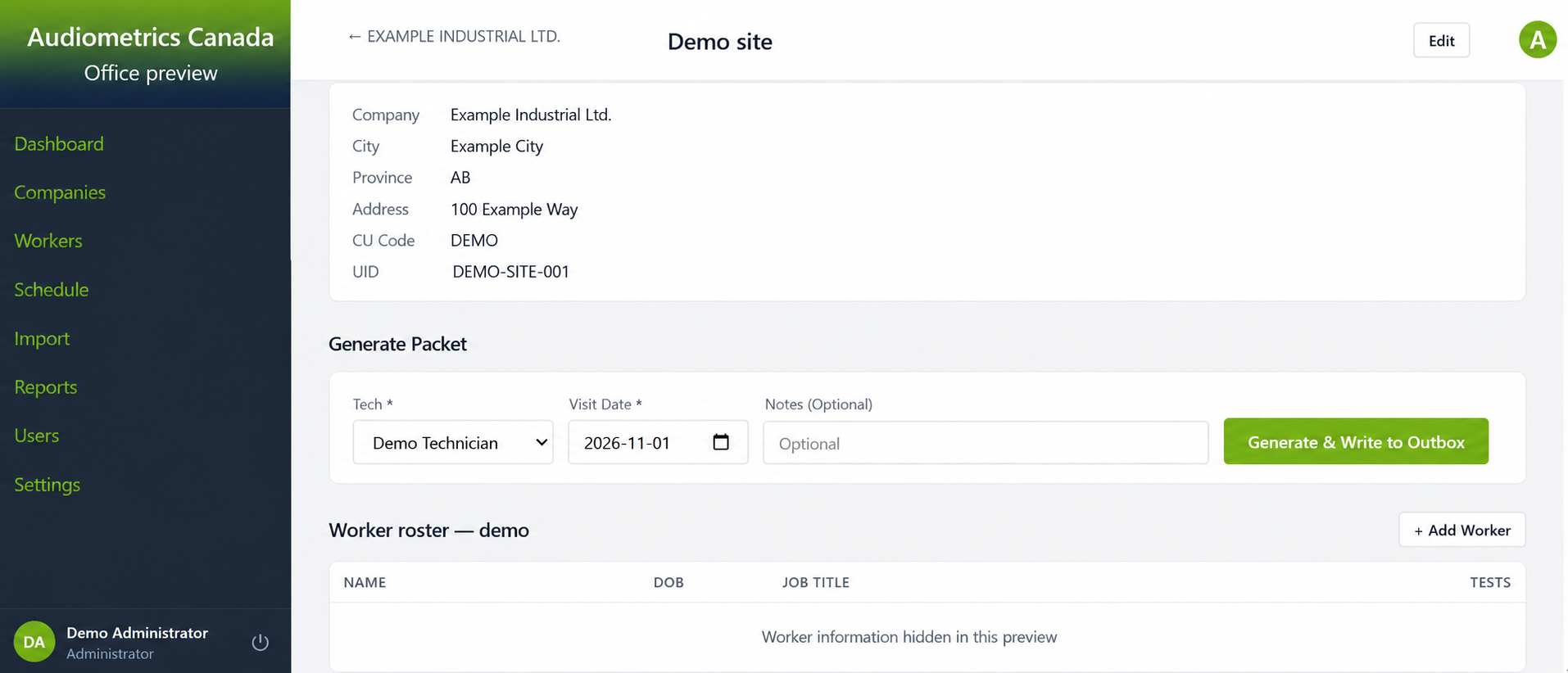
Office manages employer appointments, provider records and reporting. Windows Office development builds include scheduling and assignment-package foundations; automatic authenticated Field-to-Office delivery remains to be built.

  • Scheduling and assignments — prototype
  • Provider-owned record search and export — planned
  • Automatic authenticated sync — in development
Edited Office app preview with a fictional company, demo staff, packet generation form, and no worker records displayed.
Edited Office preview · Fictional company and staff · Worker information hidden
View full-size preview ↗
The person behind the audiogram

The worker is
the reason.
Continuity is the goal.

A worker’s audiometric history should continue across employers and testing providers. Who can see it, and when, must follow defined authorization and privacy rules.

01

History follows the worker

We’re designing one persistent identity across employers and testing providers, with each test retaining its original context.

02

Access has a purpose

Our intended model gives a verified worker ongoing access to their history. An authorized technician can consult relevant cross-provider history during an active employer appointment; that temporary access ends when the appointment is completed. Providers retain their own tests and employers receive only permitted records. Privacy validation remains essential.

03

A shared data foundation

We created CADS, the Canadian Audiometric Data Standard. As its author and steward, Audiometrics Canada is building Field and Office to put it into practice.

CADS · Created by Audiometrics Canada

A shared language for
Canada’s audiometric
records.

Audiometrics Canada created CADS, the Canadian Audiometric Data Standard: an open data specification for structuring, exchanging, and connecting occupational hearing records across employers, testing providers, and provinces.

CADS is our standard. Field and Office are how we’re putting it to work.

Explore CADS documentation →
01 / Shared records

A common language.

Defined records for workers, tests, questionnaires, providers, technicians, and equipment—designed for consistent capture and exchange.

02 / Provincial context

One framework. Local rules.

A national data foundation with versioned provincial profiles, so the context used for a test stays traceable as requirements evolve.

03 / Worker continuity

A history that connects.

We’re evolving CADS around persistent worker identity, purpose-limited authorized history access, and clear provenance across providers and employers.

Our data specification. Alongside established testing standards.

Canada already has established standards: CSA Z107.6 addresses workplace audiometric testing; CSA Z1007 addresses hearing loss prevention program management; and ASA/ANSI S3.6 specifies audiometers. CADS is intended to complement that work through a consistent data model and exchange format, with worker continuity and authorized access. It does not replace those standards or provincial requirements.

Other developers and organizations can implement CADS. Our commercial system is being developed to implement the specification. CADS remains a draft, not a designated National Standard of Canada; no CSA/ANSI endorsement, national adoption, or completed product conformance is claimed.

CCOHS: hearing conservation standards ↗ · ASA equipment standards ↗

Planned launch pricing · CAD

One company.
Your whole team.

Field and Office belong together. The subscription includes both, with unlimited staff accounts and a fee for each new completed test accepted into the database.

For our first three customers

Planned introductory rate: $99/month + $0.75/test for the first 12 months, with structured feedback.

Availability will be announced here. The commercial service is not open for registration yet.

Field + Office
$149/ month

Or $1,490/year for the subscription

+ $0.75per new completed test
successfully stored
  • Unlimited staff accounts
  • Field + Office access
  • Linked confirmation retests
  • Historical imports: no test fee
  • Standard onboarding*
  • Storage while subscribed
Subscription + annual test usage$5,538

CAD, before tax. Estimate uses standard pricing, excludes included confirmation retests and the introductory offer. *Supported import formats; substantial data cleanup quoted separately. No payment is collected on this site.

Building in the open

Development journal.

4 updates shown

Development

Ouïvia Field and Office: designing around the working day.

Two Windows development prototypes, a refined two-booth testing interface, and an agreed appointment-led workflow. See what is working and what remains to be built.

Read the November progress update
Announcement

Introducing Audiometrics Canada.

A worker-first direction for connected hearing conservation, with Alberta hearing-test companies as our first commercial market.

Read the announcement
Development

From proven workflows to a hosted product.

The product foundation and launch pricing are documented. Next: reconcile CADS and design the hosted architecture.

Read the development note
Free tool

A practical tool for hearing protection.

HPD Calc is already available, free to workers. Explore screening estimates using measured exposure or occupation references.

Explore the free tool
Available now · Free to use

Is your hearing protection enough?

HPD Calc estimates the protected noise level for earplugs, earmuffs, or dual protection. Search by occupation or enter a measured exposure, then compare against the selected jurisdiction’s limit.

Open HPD Calc

Screening estimates. Not a substitute for measurement.

A few useful answers

Where things
stand today.

Can my company subscribe now?

Not yet. The commercial platform is in development, with Alberta as the first market. Pricing shown here is the planned launch structure. Registration and customer portal access will be announced when available.

Will Field work without an internet connection?

Full offline testing is a launch requirement. The intended workflow provides offline appointments and authorized worker histories, saves tests locally and automatically synchronizes on reconnection. Two-booth local testing works in prototypes; authenticated sync and immediate history-access cutoff still require implementation and security testing.

How will worker history move between providers?

Ouïvia is designed around a continuous worker record. During an authorized employer appointment, technicians may access relevant history across providers; completing the appointment ends that temporary access, even offline. Providers retain only their attributed tests; employer access is separately restricted. Identity verification and lawful disclosure controls are still being designed.

How can a worker obtain their test results?

Our goal is ongoing verified worker access to their available audiometric history. The worker access portal is not built yet. For current records, workers should contact their employer or testing provider using applicable privacy-law access processes. This website has no worker lookup or health-record submission form.

Who created and maintains CADS?

Audiometrics Canada created and maintains CADS, the Canadian Audiometric Data Standard. It is an open draft specification that other systems can implement. Aud-Can is developing Field and Office as its commercial implementation. Provincial partnerships and nationwide adoption remain future goals.

Is Audiometrics Canada a provincial system?

No provincial adoption or partnership is being claimed. We intend to work toward provincial partnerships over time. The initial product is being developed for independent hearing-test companies.

Stay connected

Help shape what comes next.

Calls for pilot participation, feedback, and collaboration will appear in our development journal, with contact details when enquiries open.

Read our development journal